










Data management
made effortless
Enjoy the freedom to do more with Maia on your side.
ODATA (Open Data Protocol) is a web protocol designed to simplify data sharing by standardizing how data can be queried and updated across web services. It enhances data interoperability and accessibility across diverse systems, allowing developers to access data easily via HTTP protocols. ODATA promotes efficient data exchange, accelerates development processes, and facilitates the integration of different systems and applications.
Using ODATA data, you can efficiently analyze key metrics such as sales performance, customer engagement, and inventory levels. It supports real-time data integration for comprehensive trend analysis, predictive modeling, and operational efficiency tracking. ODATA enables comparative analytics for financial metrics and customer sentiment analysis, facilitating better decision-making across organizational departments by providing accessible and actionable insights from diverse, scalable datasets.
Maia enhances productivity and collaboration by providing a no-code, pre-built ODATA connector that enables swift access to data, allowing teams to efficiently manage large-scale AI and analytics pipelines.

For the quickest response to support issues, please visit the support portal.
With our connector to ODATA, you can quickly and easily move data into your cloud data warehouse.
Choose from Matillion's extensive library of prebuilt-connectors to get the data you need into your cloud-data platform, where you can transform and prepare it for analytics or AI projects
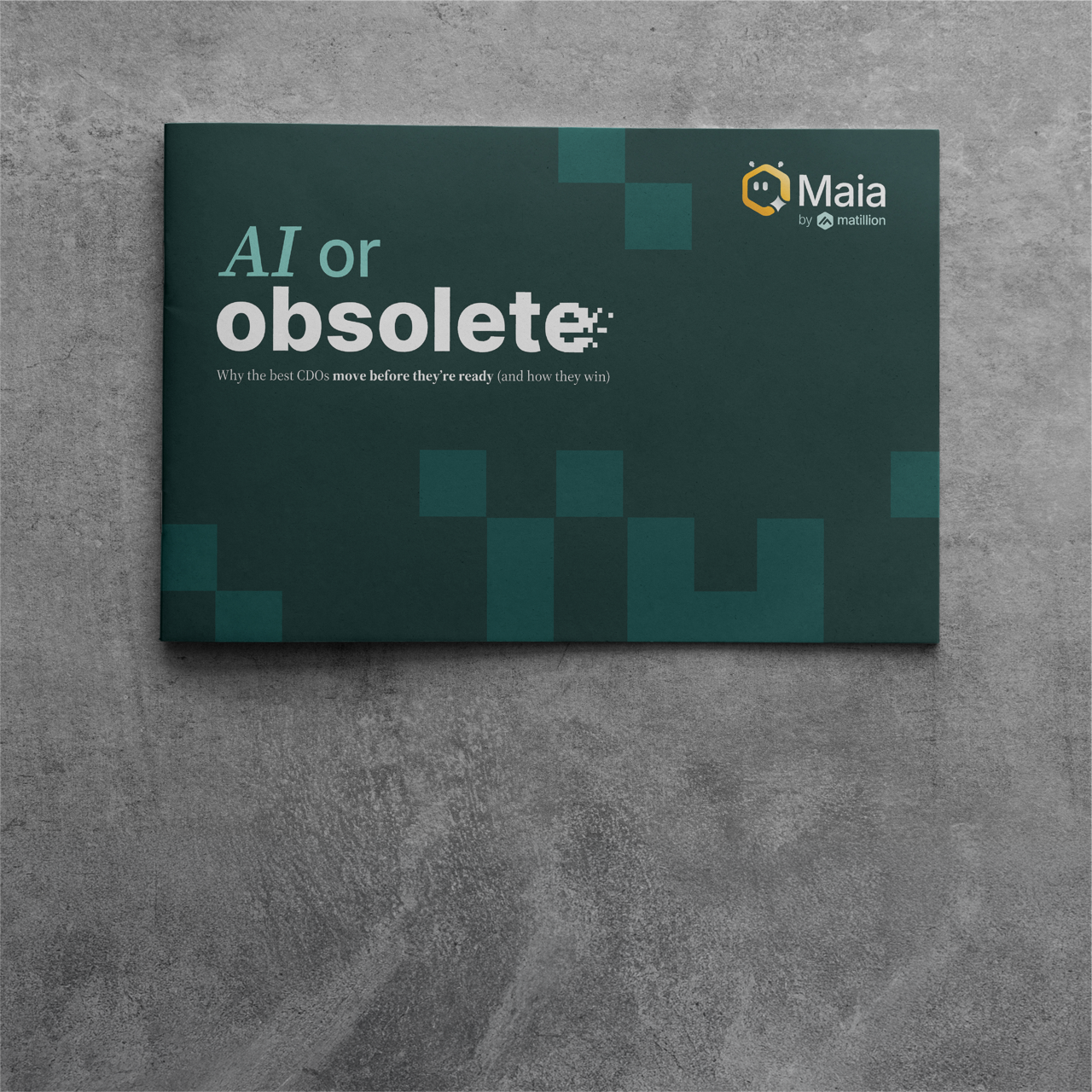
The gap between CDOs moving now and those still waiting is compounding daily. The constraint on AI value was never the models; it's how fast you can supply them with governed, AI-ready data. This executive guide shows how the CDOs already ahead get there: a proven pilot, a funded business case, and a board-ready plan to scale, in 90 days.
80% of AI POCs stall before production — not from bad use cases, but an unresourced supply side. Here's the five-stage leakage chain, and how to close it before your board notices.