
.jpeg)

.png)

Data management
made effortless
Enjoy the freedom to do more with Maia on your side.

Your board didn't kill the initiative. An unresourced supply side did.
"Where's the return on the AI portfolio we approved eighteen months ago?" - Your Board
That's the question closest to what your board is actually asking. The use cases were sound. The budget was real. Nobody in that room expected to still be waiting, eighteen months later, for a number worth reporting.
So what actually happened? A five-stage pattern turned a funded AI portfolio into activity nobody can point to. We call it the leakage chain.
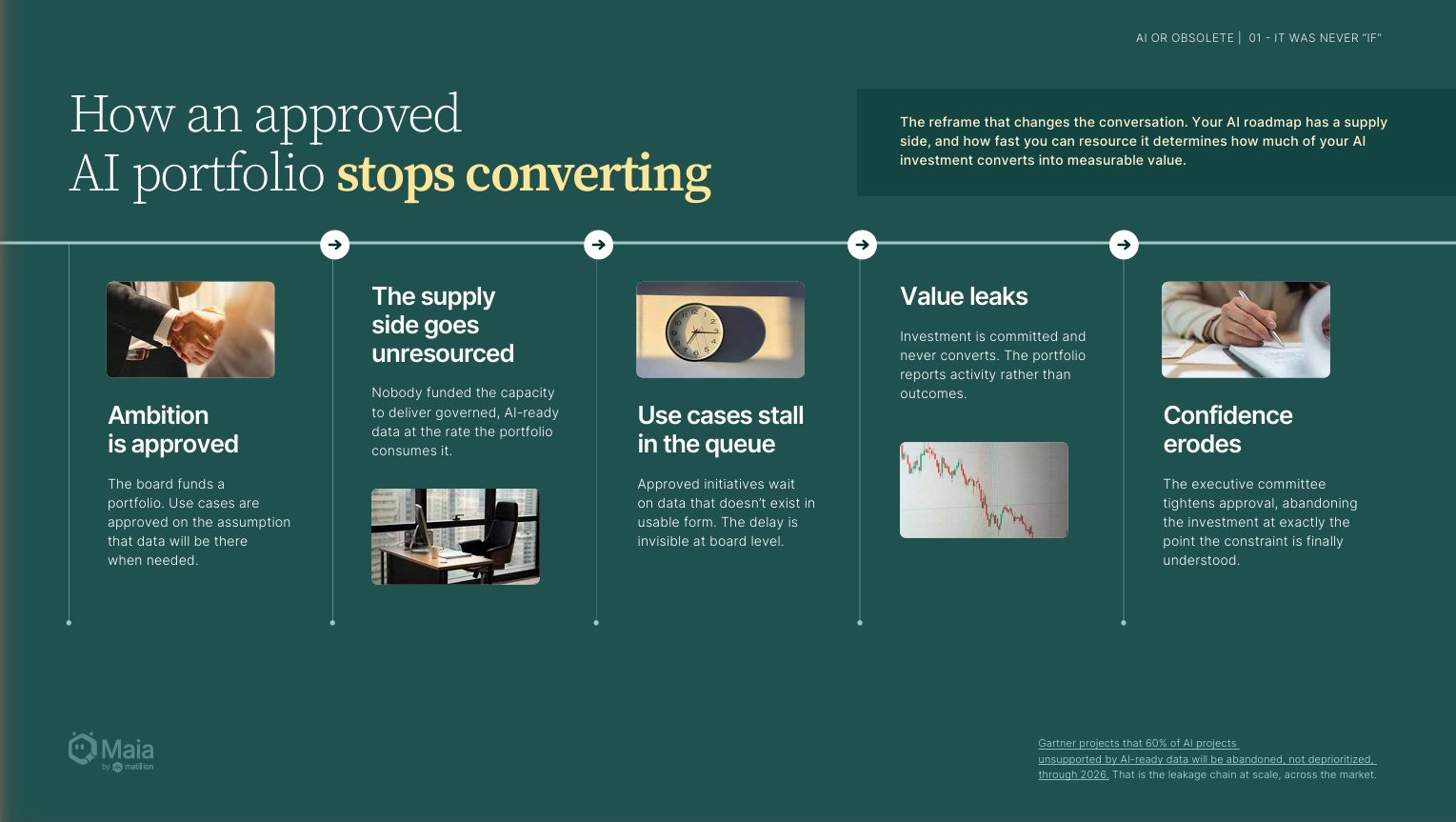
Thomas Mazzaferro, Chief Data Officer at Cyera, has watched stage four up close. He estimates that roughly 80% of AI proof-of-concepts never reach production for want of a semantic layer, and that only about 17% of AI-generated answers to business questions are accurate enough to act on. Nobody gave the data the context an agent needs to use it.
Most teams still measure whether they deployed AI. The number that matters is whether governed data reaches the systems consuming it as fast as the business invents new use cases for them.
Every assumption the analytics era ran on has broken underneath that gap. A person used to interpret the data; now autonomous systems consume it directly, with no one standing between them. Meaning has to live in the data itself, not in someone's head. Miss that shift, and stage two of the chain is already loaded before your first use case ships.
Mazzaferro says his own board now leads with three questions: How are you democratizing AI with guardrails? How are you defending against AI threats? What are the big AI bets, and what's the return on them? That board has stopped asking whether to fund AI and started testing where you sit on the chain above.
The fix is closing stage two before it opens: give your data the governance, definitions, and semantic context an agent can act on, continuously. Maia's agents build and govern that data as part of creating it, so the supply side scales with the portfolio instead of trailing it.
Do that, and stage two never opens. The portfolio your board already funded starts converting into results you can report.