











Data management
made effortless
Enjoy the freedom to do more with Maia on your side.
Amazon Redshift is a fully-managed data warehousing service designed to handle large-scale analytics efficiently and cost-effectively. It enables rapid querying and analysis of vast datasets, supporting complex queries across petabytes of data with its columnar storage and parallel processing architecture. Benefits include seamless integration with other AWS services, scalability, concurrency, and automated maintenance, offering insightful analytics and transformative business intelligence.
Using Amazon Redshift, you can perform complex analytics like calculating customer retention rates, sales forecasts, and trend analyses. Key metrics might include average order values, churn rates, and user acquisition costs. With SQL-based querying, you can analyze vast datasets swiftly, enabling pattern recognition, predictive analytics, real-time dashboards, and deep insights for evidence-based decision-making—all crucial for business intelligence.
Maia enhances productivity and collaboration for data teams by offering a code-optional, scalable pipeline platform, featuring a pre-built Amazon Redshift connector for fast, efficient data access.

For the quickest response to support issues, please visit the support portal.
With our connector to Amazon Redshift, you can quickly and easily move data into your cloud data warehouse.
Choose from Matillion's extensive library of prebuilt-connectors to get the data you need into your cloud-data platform, where you can transform and prepare it for analytics or AI projects
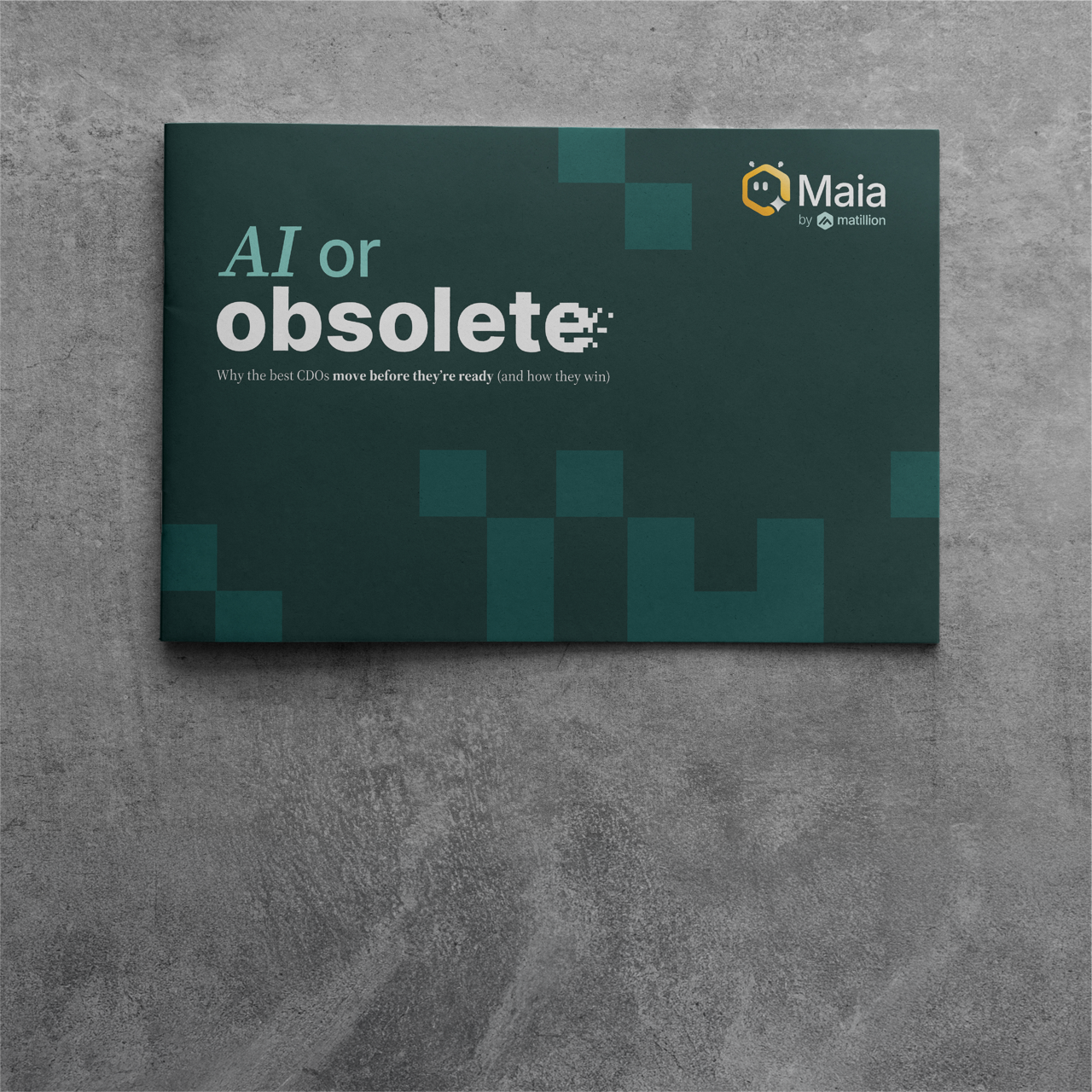
The gap between CDOs moving now and those still waiting is compounding daily. The constraint on AI value was never the models; it's how fast you can supply them with governed, AI-ready data. This executive guide shows how the CDOs already ahead get there: a proven pilot, a funded business case, and a board-ready plan to scale, in 90 days.
80% of AI POCs stall before production — not from bad use cases, but an unresourced supply side. Here's the five-stage leakage chain, and how to close it before your board notices.