
.jpeg)


Data management
made effortless
Enjoy the freedom to do more with Maia on your side.


The way most data teams work hasn't fundamentally changed in a decade. Scripts run. Pipelines break. Engineers fix them. Repeat.
Agentic AI ends that cycle.
Unlike traditional automation, which executes what it's told, agentic AI can reason through a problem, plan the steps to solve it, and act on that plan without waiting to be asked. It's the difference between a system that follows instructions and one that understands intent.
For data teams, that distinction matters. Maia automates the work that's been holding teams back, freeing them to focus on what actually drives the business forward.
AI promises to dramatically change the face of data engineering.
Agentic AI is a type of artificial intelligence that can reason, plan, and take autonomous actions to achieve goals with minimal human guidance. Unlike traditional automation, which follows predefined rules, agentic AI adapts in real time, detecting issues, optimizing workflows, and making decisions based on context. This allows organizations to reduce manual work, improve reliability, and scale operations more efficiently.
Agentic AI systems can reason, plan, and execute data workflows autonomously. Unlike rule-based automation, they detect issues, fix pipelines, and make decisions based on context, not predefined scripts. As the foundation of Maia's AI Data Automation platform, this capability reduces manual workload while improving the reliability and scale of your data operations.
Get ready to transform your data operations with intelligent agents that can reason, plan, and act autonomously across your modern data stack.
Meet Maia, the AI Data Automation platform.
Data automation has traditionally meant scripting repetitive tasks, orchestrating pipelines, or triggering alerts based on predetermined conditions. However, AI is now evolving into a more powerful phase, one where systems don't just execute programmed steps but autonomously decide which actions to take.
This transformation is powered by agentic AI: artificial intelligence systems that can reason, act, and adapt in pursuit of specific goals without constant human supervision.
Unlike conventional machine learning models or rule-based automations, agentic systems can initiate actions independently, plan complex agentic workflows, execute decisions, and learn from outcomes in real-time. This breakthrough capability is significantly reducing the manual overhead of data engineering and analytics while unlocking entirely new possibilities for data teams.
This comprehensive guide seeks to definitively answer the question, "What is agentic AI?" by exploring what agentic AI is, how it functions within the modern data stack, its practical applications for data professionals, and how it's reshaping roles in analytics engineering, operations, and data platform leadership.
The agentic paradigm represents a significant evolution beyond previous automation approaches. Understanding the agentic AI vs generative AI distinction is crucial for data teams evaluating these technologies:
| Capability | Traditional Automation | Generative AI | Agentic AI |
|---|---|---|---|
| Initiative | Triggered by predefined events or schedules | Activated by human prompts | Self-initiated based on goals/conditions |
| Task Complexity | Handles repetitive, well-defined processes | Creates content, but within static contexts | Manages dynamic, multi-step workflows with decision points |
| Contextual Awareness | Largely stateless operations | Limited contextual understanding | Maintains state with memory and planning capacities |
| Learning Mechanism | Requires manual tuning or reprogramming | Some fine-tuning capabilities | Real-time learning and behavioral adjustment |
| Typical Application | ETL/ELT pipeline execution, scheduled jobs | Code generation, question answering | Autonomous error remediation, intelligent workflow routing |
While generative AI excels at producing content from prompts, agentic artificial intelligence goes further by making decisions and taking actions based on its understanding of goals and context. Agentic systems can orchestrate other tools, conduct diagnostic investigations, escalate anomalies based on severity, or even refactor code; all with minimal human oversight during execution.
Agentic artificial intelligence isn't a single technology but rather an architectural pattern combining multiple components. To accelerate adoption and reduce infrastructure overhead, many organizations are leveraging AI as a Service (AIaaS) platforms. These cloud-based offerings provide ready-to-integrate capabilities like LLMs, memory stores, orchestration layers, and monitoring tools, enabling faster deployment of agentic architectures without requiring everything to be built in-house.
When implementing agentic systems, organizations typically integrate:
Modern agents use foundation models like GPT-4, Claude, or open-source alternatives as their cognitive core, enabling:
Effective AI agents require both:
These memory systems allow agents to perform multi-turn interactions and reflect on prior experiences when making new decisions.
Agents gain real-world capabilities through:
These tool connections are typically managed through "toolkits" or plugin architectures that define available actions.
Frameworks provide the logical structure for agent behavior:
These frameworks chain together thoughts, actions, and memory to create coherent agent behaviors.
Successful agent deployments require robust observability through:
Together, these components enable agents to act purposefully and, most critically, adapt in real-time to changing data environments.
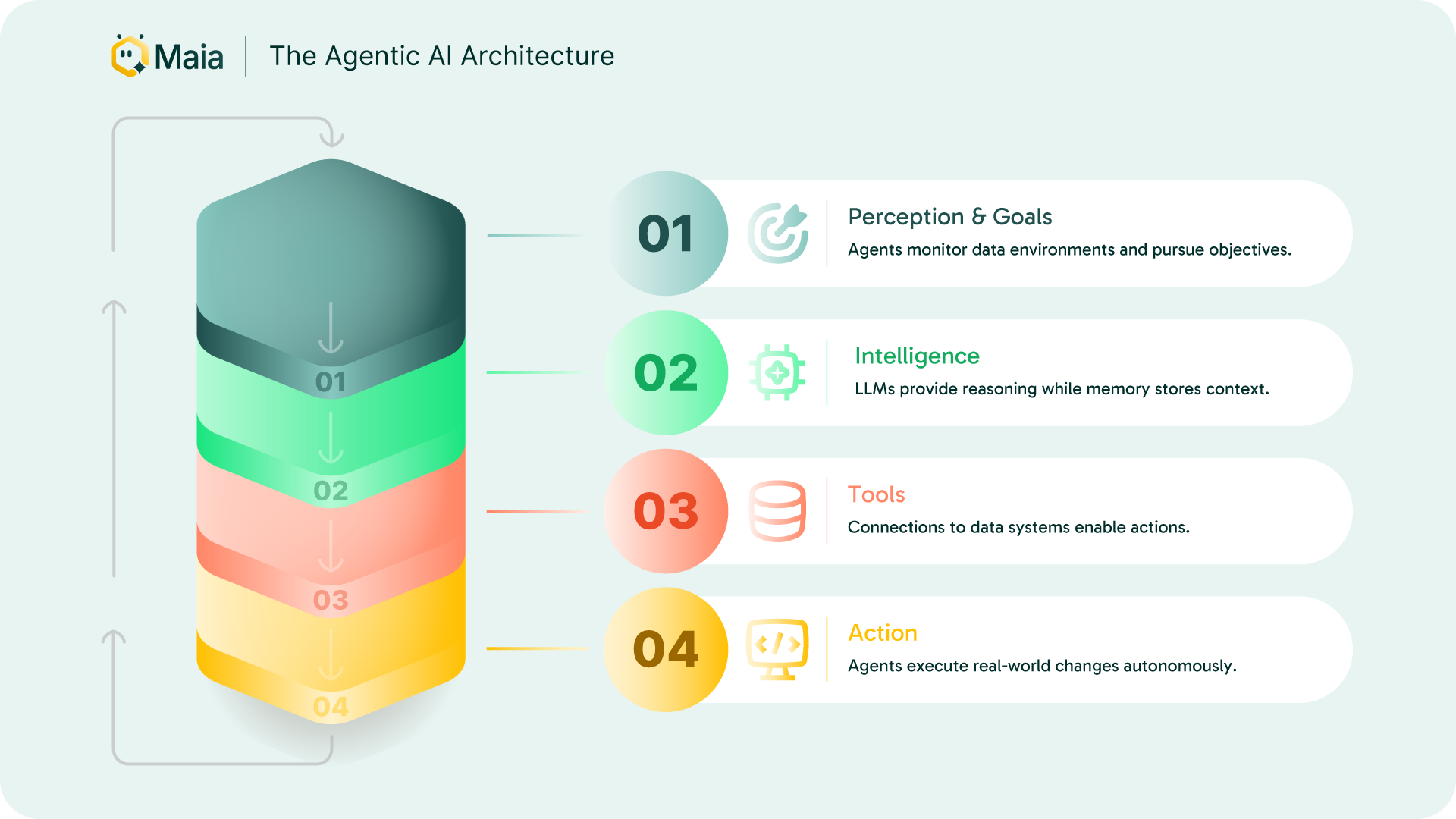
It emphasizes how agent-based AI integrates perception, reasoning, tools, and execution into a cohesive system.
Agentic AI delivers exceptional value for data-intensive organizations by automating, optimizing, and safeguarding complex workflows. Here’s how these intelligent agents are transforming work across key data functions:
Agents monitor data jobs in real time, detecting failures, analyzing logs for root causes, and automatically attempting remediation. They can also flag anomalies in usage or performance before issues arise.
When upstream schema changes occur, agents trace the downstream impact and generate proposed updates, like pull requests, to adjust affected transformations and maintain system integrity.
By analyzing patterns in warehouse usage over time, agents recommend more efficient transformations, indexing strategies, or partitioning. They can also scale compute resources automatically based on workload demands.
Analytics Engineering
Automated Insight Discovery
Agents continuously monitor dashboards and metrics, alerting stakeholders to significant changes with contextual summaries. They can even generate executive-ready updates from raw data or report revisions.
Investigation and Root Cause Analysis
When key metrics shift unexpectedly, agents execute diagnostic playbooks and trace issues through data lineage. Findings are summarized in formats accessible to both technical and business teams.
Documentation and Knowledge Management
Agents help maintain accurate, up-to-date data dictionaries, usage examples, and metadata repositories. They also track data quality stats to support ongoing governance and collaboration.
SLA Monitoring and Enforcement
Agents monitor data product SLAs, taking proactive steps to prevent violations. They can reprioritize pipeline execution based on downstream dependencies and business criticality.
Intelligent Issue Triage
When data quality issues arise, agents assign them to the right domain owners and prioritize based on impact. They also reference prior resolutions to speed up remediation.
Data Lineage and Governance
Agents document changes in table relationships and column usage, maintain accurate dependency chains, and enforce compliance standards as systems evolve.
Comprehensive Model Monitoring
Agents detect signs of data drift, concept drift, or model degradation in production. Based on observed issues, they can recommend retraining or run A/B tests to optimize outcomes.
Experiment Management and Optimization
Agents track experiment results, surface statistically significant findings, and suggest next steps to accelerate model improvements.
Model Governance and Responsible AI
From enforcing bias mitigation to maintaining explainability thresholds, agents help ensure responsible AI practices. They can also automate compliance reviews using predefined governance frameworks.
To illustrate the agentic approach in action, consider this realistic scenario:
Problem: A critical data pipeline fails during overnight processing due to a missing database table.
Traditional Response: An on-call engineer receives an alert, investigates logs, identifies the cause, makes a fix, submits a PR, waits for approval, and restarts the pipeline, potentially taking hours.
Agent Response:
This workflow isn't theoretical. Such systems are already being implemented using frameworks like LangChain, CrewAI, and internal orchestration layers built by forward-looking data teams.
Adopting agentic AI creates substantial advantages for data operations:
Traditional automation requires extensive rule creation and maintenance. Agents can operate effectively in less deterministic environments by leveraging reasoning capabilities, contextual understanding, and embedded domain knowledge. This makes them significantly more adaptable to edge cases and evolving data schemas.
Rather than waiting for scheduled jobs or manual review processes, agents can continuously monitor conditions and act immediately when needed, dramatically improving data freshness, trust metrics, and incident resolution times.
Many data management tasks involve repetitive work: validating failed jobs, communicating with stakeholders and verifying data lineage. Agentic systems can handle these responsibilities faster and more consistently than human operators.
By offloading operational noise and routine maintenance, agentic AI allows data professionals to concentrate on higher-value work: improving analytical models, exploring business logic innovations, or enabling self-service analytics capabilities. This is only possible when the underlying data is well-integrated and reliable.
As data volumes and complexity grow, agentic systems can scale horizontally without proportional increases in staffing, allowing data teams to support more business use cases without linear headcount growth.
While agentic AI offers transformative potential, it also introduces new considerations that require careful management:
Agents must be able to justify their actions and decisions. Without transparency, organizations will struggle to trust autonomous processes. Essential capabilities include:
Agents require well-defined operational boundaries, including:
Because agents operate asynchronously and may evolve based on context, debugging them presents unique challenges compared to deterministic systems. Teams need specialized observability tools and versioning systems to manage these complexities.
Deploying agentic AI isn't purely a technical initiative, it requires cultural alignment. Teams must accept responsibility shifts from humans to autonomous systems and develop new collaboration models between staff and AI agents.
As intelligent agents become embedded throughout the data stack, data professionals are evolving from technical specialists into strategic business partners:
| Role | Traditional Focus | New Agent-Enhanced Focus |
|---|---|---|
| Data Engineer | Constructing and maintaining pipelines | Translating business requirements into agent-driven data solutions |
| Analytics Engineer | Creating and delivering dashboards | Aligning automated insights with key business metrics and decisions |
| Platform Engineer | Managing infrastructure and tools | Designing agent ecosystems that directly support business outcomes |
| Data Product Manager | Backlog management and governance | Measuring and maximizing the business impact of AI-powered data products |
| Data Scientist | Algorithm development and modeling | Creating business-focused experimentation frameworks with agent assistance |
This transformation elevates roles from technical executors to strategic business enablers. With intelligent agents handling complex technical tasks, data professionals can focus on what matters most: driving tangible business value.
For organizations considering agentic AI integration, a measured approach yields the best results:
Start with a specific, well-understood task, such as anomaly detection for a single critical pipeline or automated documentation generation.
Explore established frameworks like:
Maintain approval checkpoints during initial deployments to build confidence and refine agent behavior:
Document everything agents do:
Track not just task completion, but meaningful business outcomes:
The age of agentic AI has arrived, and data teams stand at the forefront of this transformation. What began with basic scripts and scheduled jobs is evolving into an ecosystem of intelligent, self-directed systems. For organizations that embrace this shift, agentic AI promises faster insight delivery, more reliable data operations, and a more efficient path to business impact.
However, successful adoption won't be instantaneous.
It will require new architectural approaches, trust-building mechanisms, and fresh perspectives on human-machine collaboration. The question isn't whether agents will become part of your data stack, but how effectively you'll design, supervise, and scale them to meet your strategic objectives.
By starting small, focusing on concrete use cases, and building competency incrementally, data teams can harness the power of agentic systems while managing the associated risks.
Those who master this balance will gain significant competitive advantages in their ability to deliver timely, reliable, and actionable data insights.
Every capability described in this article, autonomous triage, self-healing pipelines, real-time observability, depends on one thing the article hasn't named yet: the data layer underneath it.
Agents don't operate in a vacuum. They need governed, structured, production-ready data to reason from. Without it, even the most sophisticated agentic framework is reasoning over noise.
That's the problem most organizations hit first. Not a lack of ambition, and not the wrong frameworks. The bottleneck is the data engineering layer, still manual, still slow, still human-scaled in a world where demand is anything but.
Maia was built specifically for this moment.
As the industry's first AI Data Automation platform, Maia deploys an always-on team of AI agents that builds, monitors, troubleshoots, and maintains the pipelines your agentic workflows depend on. When a schema changes overnight, Maia catches it. When a pipeline fails, Maia traces the root cause, generates the fix, and alerts the right engineer, often before anyone knows there's a problem.
The scenario earlier in this article, an upstream table rename breaking a critical pipeline, isn't a hypothetical. It happens daily. And for teams still relying on on-call engineers to chase it down manually, it's expensive.
Maia handles it autonomously.
If you're building toward an agentic data organization, start with the foundation that makes it viable.