
.png)
Data management
made effortless
Enjoy the freedom to do more with Maia on your side.

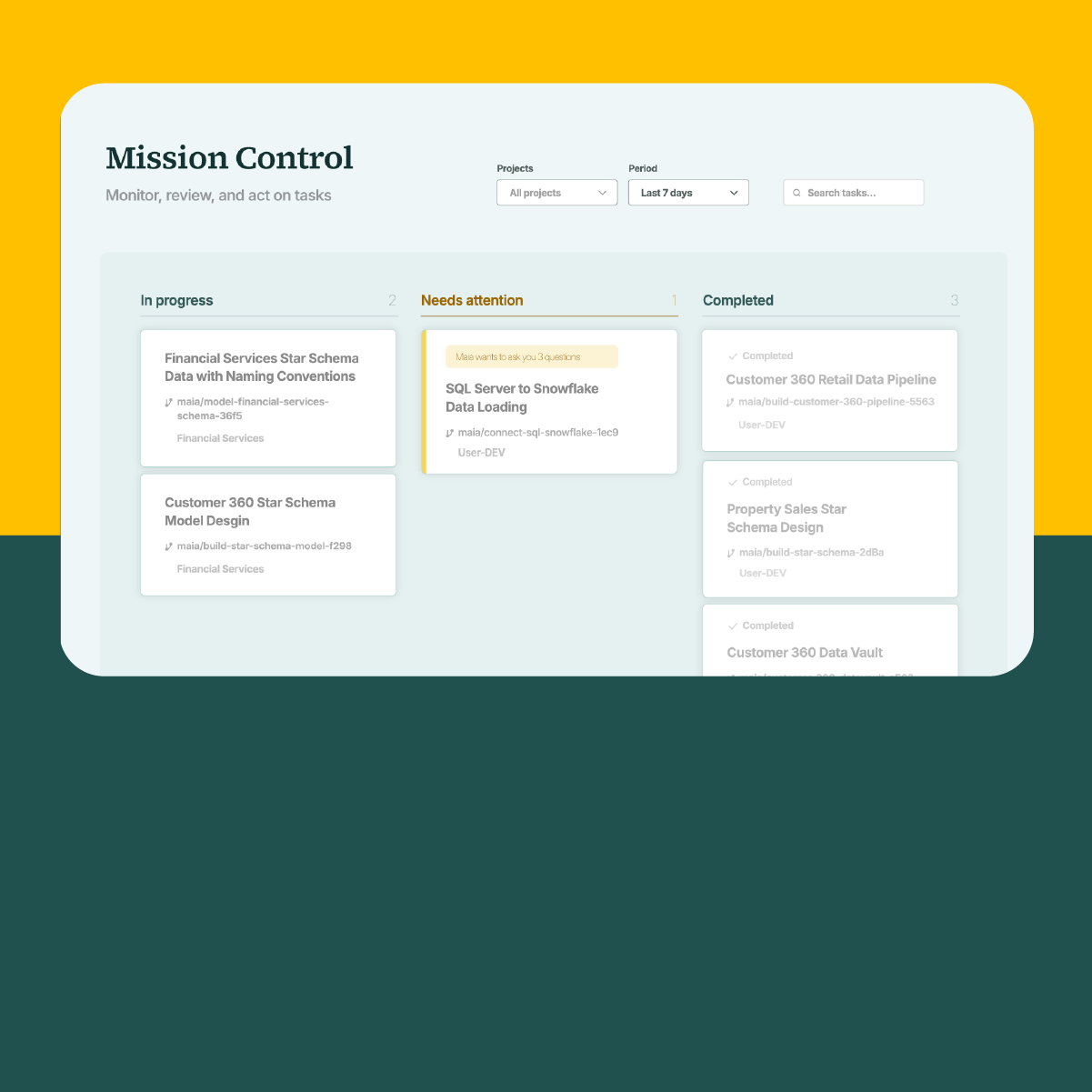
Mission Control is the operating layer for Maia's agents. It runs every job, migrations, new pipeline builds, schema-drift fixes, Reverse ETL syncs, FinOps work, in parallel on a single Kanban board, under one governance model, with human review checkpoints before anything ships to production. Engineers stop chasing dashboards that won't refresh. They start managing outcomes.
You're mid-flow on something that matters, a new pipeline build, a model the AI team has been waiting on. Then an analyst messages you: "The revenue dashboard isn't refreshing. Can you look into it?"
No error. No cause. No idea what's downstream. Just a business user who needs their numbers and assumes you'll know where to start.
So you drop what you were doing. You trace the lineage by hand, hunt for the broken step, work out which reports are sitting on stale data, and figure out the fix. By the time you've closed the loop, half your day is gone and the work you actually planned to do hasn't moved.
This is the part of autonomous data engineering nobody hired for. It happens constantly, and it keeps the whole team stuck in reactive mode, answering "can you look into this?" instead of building. It also scales the worst: every new pipeline is another one of these waiting to happen, every new source another schema waiting to drift.
Maia Mission Control does the investigation for you. It changes who chases the root cause, and frees you to stay on the work that moves the business forward.
Mission Control is the operating layer for Maia Team's AI agents. It runs multiple streams of data engineering work in parallel under one governance model, with full observability over what every agent is doing, what's queued, and what's gone to review. The AI agents do the building; you stay in control of what ships.
All running concurrently. All visible on one Kanban board. All moving through review checkpoints before deployment.
The engineer doesn't disappear. The engineer becomes the manager.
"The biggest shift isn't speed. It's where the engineer spends their time. Mission Control takes them out of the triage seat and puts them in control of allocating Maia's data engineering capacity. Same person, completely different, even more impactful job."
Arun Anand. Senior Product Marketing Manager
Mission Control is a Kanban board, but the columns are what matter:
Backlog. Lower-priority work Maia hasn't started yet. New pipeline asks coming in from Jira, Slack, or the API. Documentation backlog. Legacy pipelines waiting to be modernised.
In progress. Work the agents are actively building, fixing, or migrating. Each card shows what Maia is doing, what step it's on, and how confident it is in the approach.
Needs attention. This is the column that flips the operating model. When Maia finds an issue, runs a diagnosis, and prepares a fix, the card lands here. Not "in progress." Needs attention. Maia has done the work and is holding the change until a human approves it.
Done. Completed work with full audit trail: what changed, why, who approved it, what downstream effect it had.
It's worth highlighting the mechanism of that "needs attention" column. The agent performs a root cause analysis, proposes a narrow, scoped fix, and presents this work for human judgment. Then the agent stops, because it knows it can't ship without a human signing off. That's human-in-the-loop governance by design, not by policy.
Take that refresh failure from the top of this post. The cause turns out to be schema drift, a column renamed at the source overnight.
In Maia, the alert doesn't say "pipeline failed." It says:
Pipeline failed. Classification: schema drift, column renamed at source. Confidence: high. Step: extract CRM contacts. Proposed fix: update column mapping (contact_email → email_primary). Blast radius: contained, no downstream tables affected.
The agent has already compared the current schema against the schema from the last successful run. It's a deterministic diff: same data type, same position, different name. Not a guess. The CRM team renamed a column overnight.
The engineer opens Mission Control. The card is in needs attention. They see Maia's reasoning in plain English. They see the line-by-line diff. They see the four downstream pipelines queued behind this one, and the two BI reports sitting on stale data, including the one the analyst was asking about. They can ask Maia follow-up questions in line. They approve the fix.
Total engineer time: minutes, not a half-day investigation. And the engineer never had to log into a single system to trace the problem.
Coding agents speed up a single workflow. You still work one job at a time. Mission Control is different: it's where autonomy becomes an operating model rather than a faster way to do one task. Three things change the moment you run it.
You can see everything. One board shows what needs doing, where capacity is going, and which systems, pipelines, and workflows are generating the most work. The context-switching tax, orchestration tool, observability tool, data quality tool, ticketing system, and Slack disappears. And because every job and every failure sits in one place with one audit trail, root cause analysis stops being a five-tool scavenger hunt. The information is already on the board.
You run jobs in parallel. This is the throughput shift. A migration, a backlog of pipelines needing documentation and tests, schema-drift fixes, Reverse ETL syncs, FinOps work, all running concurrently, each doing work that used to need a dedicated engineer. Capacity is decoupled from headcount. The same team supervises many agents instead of staffing each job by hand.
You get measurable execution ROI. When every change carries a record of what it did, what it touched, and who approved it, throughput stops being a feeling and becomes a number. That's the conversation a VP of Data Engineering wants. For a CDAO, the same board answers the trust question every executive asks first — "how do I know what the agents are doing?" — because every action is visible, every decision auditable, every change human-approved before it reaches production.
This is the scope shift. A legacy ETL migration that was a 12-month consulting project becomes weeks of agent work and human review, the kind of result already on record with Maia customers. Balfour Beatty had a senior engineer reverse-engineer opaque legacy pipeline logic in 6 minutes instead of a full week. Sophos cut documentation and testing tasks from 5 days to 30 minutes. Edmund Optics avoided five hires and over $500K in cost. None of these teams ran Mission Control, but the throughput it operationalises is the same throughput they're already seeing.
The data engineer's job stops being reactive. You set the rules, review the work, approve the changes. Not faster data engineering, a different practice.
Mission Control is part of the Spring 2026 launch. If the backlog is winning and you're spending your days chasing other people's broken dashboards, that's the problem this was built for.