
.jpeg)

Data management
made effortless
Enjoy the freedom to do more with Maia on your side.


The data engineering landscape is going through its most significant shift since the move to cloud data warehouses. AI isn't just changing how data engineers work. It's changing what data engineering is.
Demand for real-time analytics, scalable operations, and AI-ready data products is accelerating faster than traditional delivery models can handle. The teams that recognize this aren't looking for better tools. They're adopting a fundamentally different operating model.
Enterprises are under pressure to deliver AI-ready data, but the way data work gets done hasn't changed. Most teams are still trapped in manual pipeline builds, reactive fixes, documentation drift, and constant maintenance. As demand accelerates, backlogs grow and AI initiatives stall not because of ambition, but because the data operating model can't scale.
Understanding how AI maturity has evolved in data engineering helps explain why a new category was inevitable, and why the organizations moving fastest are the ones that have stopped thinking about AI as a productivity feature.
AI is reshaping data engineering at a structural level. The maturity curve runs from early assistants that accelerated individual tasks, through embedded intelligence that optimized workflows, to Maia, the AI Data Automation platform that automates the operational layer of data engineering while preserving governance, control, and enterprise standards. The impact is structural, not incremental. Customers reduce manual data work by over 90%, move delivery from weeks to hours, and scale output without adding headcount. Engineers shift from pipeline maintenance to data product ownership and strategic enablement of AI initiatives.
As demands grow, the bottlenecks of human-scale data engineering are becoming impossible to ignore
Manual workflows, hand-coded pipelines, and reactive fixes can't keep pace with AI-driven demands. To meet AI demand, CDAOs must transition to an automated delivery model that decouples headcount from data throughput, amortizing technical debt at machine speed rather than through expensive human intervention.
The evolution from static ETL processes to agentic systems represents perhaps the most significant paradigm shift in data engineering since the move to cloud data warehouses. It's not just about automation. It's about creating systems that can reason about data context and purpose.
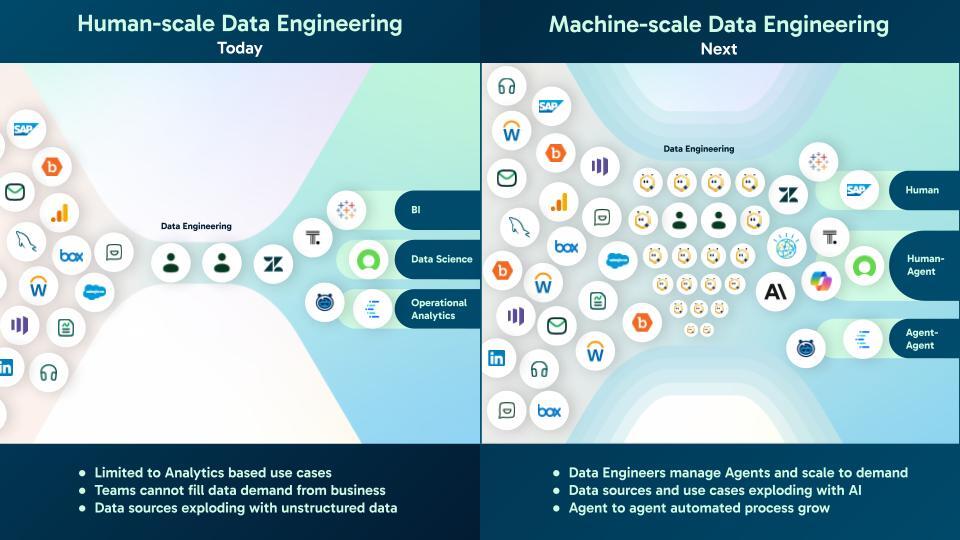
The maturity curve: Human-led workflows give way to agent-augmented and agent-autonomous data engineering.
The promise was straightforward. What if data engineers could describe what they wanted in plain English and get working pipelines? Early AI assistants in data engineering delivered exactly that. Natural language translated into pipeline logic. Boilerplate code disappeared. Context-aware schema suggestions arrived automatically.
The real impact wasn't just speed. It was access. Junior developers could contribute meaningfully from day one. Senior engineers moved toward higher-value architectural work. The learning curve for new team members flattened dramatically.
But assisted development had a ceiling. It made individual engineers faster. It didn't change the delivery model. As demand grew, teams still hit the same capacity wall.
The next shift moved AI from a tool you called upon to intelligence woven directly into the operational fabric. Rather than helping engineers write pipelines, embedded AI started watching pipelines, learning from them, and acting on them.
The intelligence layer ensured automation remained aligned with enterprise reality. It captured business rules, architecture standards, governance requirements, and institutional knowledge.
Schema drift detection. Root cause analysis. Performance optimization that understood downstream dependencies before suggesting a change. Organizations began shifting from reactive to proactive data operations. The mental overhead of constant monitoring decreased. Engineers focused on building rather than firefighting.
Embedded intelligence was a meaningful step forward. But it still required humans to hold the system together. Decisions were faster and better informed. The work was still fundamentally manual.
This is where the operating model changes entirely.
The transition to AI-readiness requires a new category: AI Data Automation. Unlike traditional tool-assist models, where humans use software to write code, AI Data Automation shifts the entire burden of planning, execution, and monitoring to agentic systems.
Maia is the industry's first AI Data Automation platform, built to automate the operational layer of data engineering while preserving governance, control, and enterprise standards.
This isn't a smarter assistant. It isn't a feature bolted onto an existing platform. Maia is an AI Data Automation platform, not a single AI feature, and not just a collection of agents. It is a platform architecture that automates how data work is executed, governed, and scaled across the enterprise.
Maia consists of three tightly integrated components. Maia Team is an always-on workforce of AI agents that handles operational data work such as building, modifying, optimizing, and maintaining pipelines and data products.
Maia's architecture is agentic, meaning it is composed of multiple intelligent agents that work collaboratively to achieve the goal of generating data pipelines. Each agent is designed to mimic the role and responsibilities of a specific persona within a data team. For example, there is a Data Engineer Agent, a Data Analyst Agent, and a DataOps Agent, each with its own set of tools and capabilities.
The Maia Context Engine is the intelligence layer that ensures automation remains aligned with enterprise reality. It captures business rules, architecture standards, governance requirements, and institutional knowledge. Its capabilities include business and semantic awareness, metadata and data awareness, governed standards enforcement, documentation and lineage alignment, and data product consistency over time.
Maia Foundation is what makes AI Data Automation viable in real enterprise environments. It provides the secure, governed, cloud-native infrastructure where autonomous execution happens. Previously known as the Data Productivity Cloud, the Foundation includes 130+ prebuilt connectors, a low-code visual pipeline designer, pro-code support for SQL, Python pushdown and dbt, pushdown architecture for warehouse-native processing, Git-based version control, and enterprise security and governance controls.
Together, these three components form a platform that removes the structural constraints of traditional ETL. Moving to an agent-driven model allows CDAOs to transform the data organization from a cost-heavy plumbing unit into a high-velocity data product factory. AI Data Automation enables the creation of a self-improving platform where agents work 24/7 to manage data lifecycle tasks, turning data into a competitive advantage rather than a perpetual maintenance burden.
Most AI tools in data engineering are positioned as overlays. They sit on top of existing stacks, help at the task level, and hand back control once the suggestion is made. Their context is limited. Their governance is inconsistent. Their value stops at the tool boundary.
Maia is a platform architecture that automates how data work is executed, governed, and scaled across the enterprise. Automation runs within the same enterprise foundation that governs the entire data lifecycle, giving it visibility across pipelines, data movement, execution, and operations. Every AI decision is auditable. Every output is traceable.
Composable, API-first architecture isn't just about flexibility. It's a strategic enabler for AI agents to operate independently while staying connected to the business logic of your pipeline.
Business users describe a fundamental change in how their organizations think about data. The traditional bottleneck, requiring deep technical expertise to access and transform data, dissolves. Analytics teams can describe what they need in plain English and get production-ready pipelines. Maia autonomously handles the data engineering work typically outsourced to expensive consulting firms. Instead of having to scale headcount linearly with demand, organizations use Maia as an agentic data team working 24/7 at a fraction of contractor rates.
Technical teams shift their focus toward strategic architecture, data product ownership, and governance rather than routine implementation. These are the benefits of data automation showing up in practice: the backlog clears, new initiatives get resourced, and the data team stops being the bottleneck and starts being the enabler.
The organizations that will define the next decade aren't just adopting AI features. They're thinking systematically about their data operating model.
Getting there requires four foundations working together.
A technical foundation built on robust infrastructure, broad connectivity, and comprehensive observability. A cultural shift that moves the team's identity from builders of pipelines to owners of data products. A governance framework with clear boundaries, escalation paths, and measurable outcomes. And continuous learning through feedback loops that improve both AI performance and human oversight over time.
Leading enterprises are already running agentic systems. Book your Maia demo to join them.