




Data management
made effortless
Enjoy the freedom to do more with Maia on your side.

.png)
Evaluating enterprise data software has always been straightforward: Does the query return the correct result? Does the pipeline complete within the SLA? Evaluating an AI data engineer, however, is a completely different challenge.
Maia Teams isn't just another AI assistant. It operates as an autonomous data engineer. Backed by the Maia Foundation platform and powered by a Context Engine, Maia translates complex business concepts into concrete tables, entities, metrics, and documentation. It interacts with users, asks clarifying questions, inspects schemas, builds pipelines, and adapts when enterprise data is messy or ambiguous.
Because Maia operates through open-ended, multi-turn conversations and live environment modifications, traditional unit testing falls short. To ensure high accuracy, reliability, and cost-efficiency across model updates, we built a dedicated, end-to-end evaluation framework.
Here is an inside look at how we rigorously test, benchmark, and continuously improve Maia.
Evaluating a conversational AI agent operating in a live enterprise environment requires simulating the full customer lifecycle. We don't just test prompt-and-response outputs in isolation; we put Maia through a complete end-to-end operational loop.
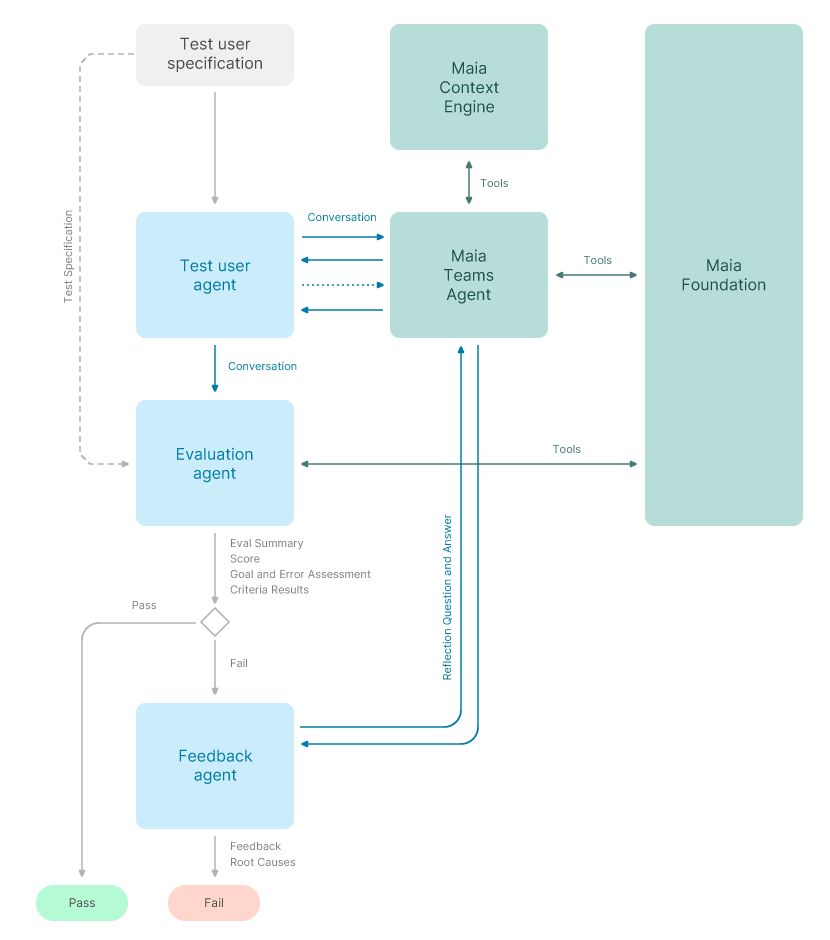
Our evaluation framework relies on five main components:
At the core of every evaluation is a Test Specification. This spec provides everything required to simulate a user attempting to achieve a goal within a realistic enterprise environment.
Rather than running against pristine demo databases, test specs link directly to customer-like instances in the Maia Foundation, complete with complex schemas, conflicting documentation, and messy relationships.
Below is an actual test specification used in our benchmark suite:
  goal: "Create a pipeline that analyzes cost variance between charges and insurance payments by health condition"

  successCriteria:
    - criteria: "Output contains exactly 19 health condition rows"
      importance: CRITICAL
    - criteria: "Exactly 5 conditions show negative variance (insurance paid MORE than charged)"
      importance: CRITICAL
    - criteria: "Variance is calculated as hospital_charges minus insurance_payments "
    - criteria: "'Essential Hypertension' is among the conditions with negative variance"

  testEndCondition: "End when the agent confirms the pipeline compares hospital charges to insurance payments"

  testContext:
    - "Business domain -> Hospitals bill for services, insurance pays a portion."
    - "Patients have health conditions documented in records."
    - "Invoices track hospital charges. Insurance claims track payments."
    - "Patients may have insurance coverage that links them to the payer system."

  instructions:
    - "If Maia asks about connecting hospital to insurance: Patients with insurance have enrollment records."
    - "If Maia tries matching by name/birthdate: That approach is unreliable for system integration."

testInput:
  testName: "Condition-Based Cost Variance"
  branch: "test-condition-cost-variance"
  startingPrompt: |
    Finance needs to understand the gap between what we bill and what we collect.
    Can you show me the variance by patient health condition?
I want to identify which conditions have the largest discrepancy between charges and payments.A real user rarely provides a perfect, complete specification in a single prompt. They might leave out critical details, use domain jargon, or ask for high-level concepts that rely on the Maia Context Agent to resolve.
To replicate this, our Test User Agent consumes the specification and initiates the conversation.
Once the interaction concludes, the Evaluation Agent inspects the results.
Crucially, the Evaluation Agent does not merely scan the text of the chat. It possesses its own toolset with full access to the Maia Foundation environment. It executes verification queries directly against the data warehouse, inspects newly generated pipelines, checks table schemas, and verifies created artifacts.
+-----------------------------------------------------------------------------------+
|                              EVALUATION SCORECARD                                 |
+-----------------------------------------------------------------------------------+
| Test Case: Condition-Based Cost Variance                                          |
| Status: PASSED (Score: 92/100)                                                    |
+-----------------------------------------------------------------------------------+
| Criteria                                 | Importance | Result | Impact           |
+------------------------------------------+------------+--------+------------------+
| Output contains 19 health condition rows | CRITICAL   | PASS   | Met              |
| Exactly 5 conditions show negative var.  | CRITICAL   | PASS   | Met              |
| Formula: hospital_charges - payments     | HIGH       | PASS   | Met              |
| 'Essential Hypertension' present in list | MEDIUM     | PASS   | Met              |
+-----------------------------------------------------------------------------------+
| Evaluator Notes:                                                                  |
| Data pipeline successfully executed. Warehouse state matches target criteria.     |
+-----------------------------------------------------------------------------------+
The Evaluator assigns weighted scores to each criterion based on its defined importance (e.g., CRITICAL, HIGH, MEDIUM). If the aggregate score crosses a predefined threshold (typically 85%), the test passes.
When a test fails, knowing that it failed isn't enough. Engineering teams need to know why.
To automate this root-cause analysis, we employ a self-reflection loop:
With hundreds of automated test scenarios running across diverse domains, we maintain an objective benchmark of Maia's capabilities. Foundation AI models evolve rapidly, offering new variants promising enhanced reasoning, lower latency, or reduced costs. Our evaluation suite allows us to instantly benchmark these LLMs, measuring performance across diverse workload profiles before any production deployment. By running aggregated benchmark suites across multiple model providers, we strike an optimal balance between execution speed, cost, and analytical accuracy.
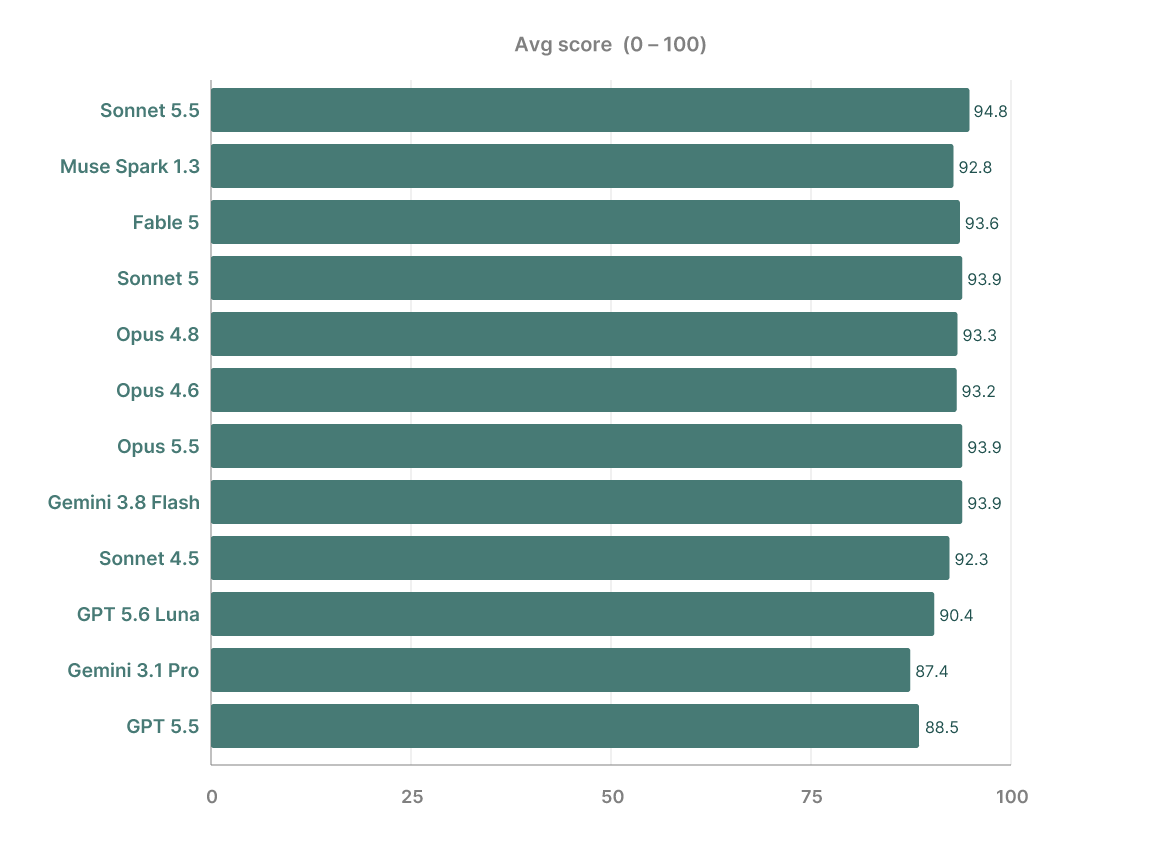
The chart above illustrates Maia's performance scores across various foundation models. Our current production model, Opus 4.6, consistently delivers top-tier results. While scores are comparable across the Anthropic family, performance dips slightly with models like GPT 5.5 and Gemini 3.1. It is interesting to note that in this particular benchmark set, Fable grade models are not needed to provide the required level of performance.
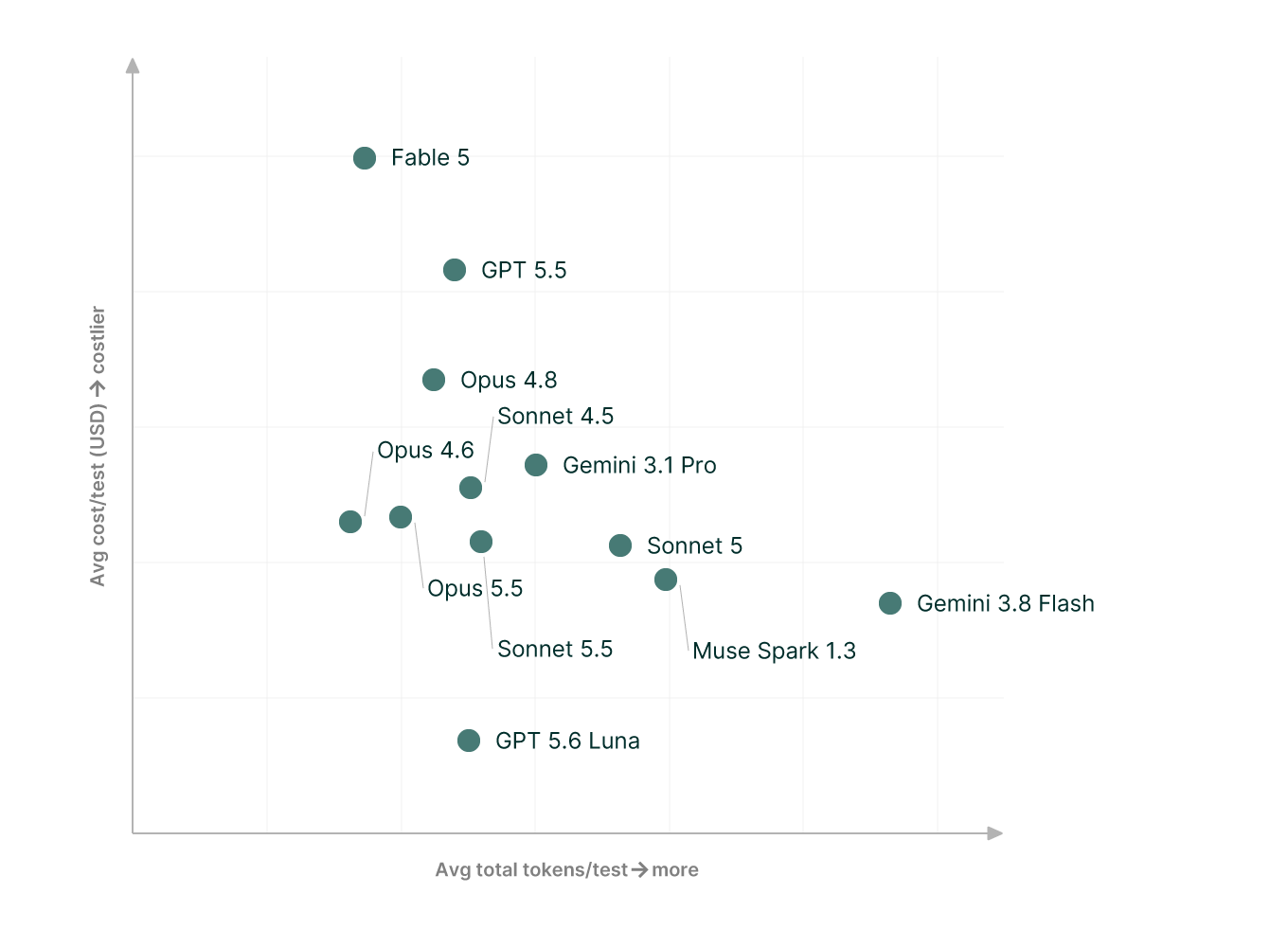
Efficiency metrics further validate our strategy. Until recently, Opus 4.6 stood out as our most efficient model, optimizing both token usage and cost. While alternatives like Fable offer similar capabilities, they incur twice the cost with negligible performance gains. Similarly, Sonnet 4.5 proves less economical than Opus 4.6; its weaker performance necessitates increased processing to reach an answer, resulting in higher overall costs despite a lower per-token price. The figure also shows how Opus 4.8 increased token usage and cost disproportionately, and it took the recent release of Opus 5.5, with a cost reduction, to restore the balance.
The recent release of Opus 5.5 and Sonnet 5.5 shows how quickly the balance between cost and performance can shift, which is why we re-run the full benchmark suite on every new model before it reaches production. This rigorous benchmarking ensures we deliver peak performance and value to every customer.
Building reliable AI agents for enterprise data engineering requires moving beyond simple static evaluation. By pairing dynamic user simulation with platform-level artifact verification and automated self-reflection, our evaluation framework ensures that Maia consistently delivers robust, reliable data solutions.